Hands: Part 2

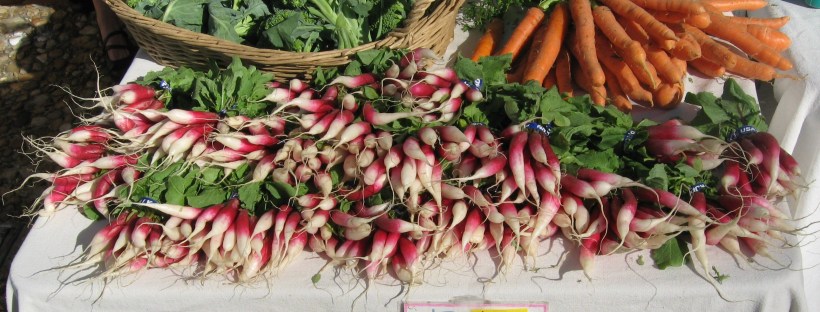
As long as I’m listing what I miss using my hands for, I might as well ramble on a bit more. I miss the responsibility my hands gave me. I miss choosing fruit at the farmer’s market: laying a smooth, firm tomato in my hand, rubbing my thumb over the amber fuzz of a peach, picking up produce to examine the color. Raising greens and herbs to my nose is a sweet little luxury I never knew to cherish. Sometimes at the farmer’s market, Evan would buy me flowers. One time, he bought me a three-foot tall sunflower. I held it over my shoulder like a parasol. Usually, though, he would buy me white hydrangeas – the flowers I carried on our wedding day. I long to wrap my hands around them again and hold them in front of my heart.

Then, of course, the cooking was such a joy. I carefully made a menu and gathered ingredients at the market. Next, I used ceramic knives to slice through the fruits and vegetables, tomato pulp leaking onto my cutting board, strawberry juice staining my butcher block. I miss the rough wooden spoons I use to mix beans, lentils, and spices in with my market finds.

I even loved cleaning up after cooking. My mother-in-law, Brenda, bought me an amazing book for my birthday. Basically, it gave formulas for how to make household cleaners, disinfectants, scrubs, and detergents using natural ingredients like lemon, white vinegar, and castile soap. I used to slice and squeeze lemons, collecting the juice in empty jars I saved throughout the week. I would add in the right amounts of soap or water, vinegar or salt, and make pretty labels for them. I loved how my hands smelled clean and a bit like sunshine after I spent a few hours scrubbing the bathtub, all the sinks, countertops, and table. At the end of all that cooking and cleaning, my hands were dry and tired, and I felt at peace, like I had captured the present and lived in my senses with my human needs. I still find serenity in the sound of a rough sponge scrubbing.

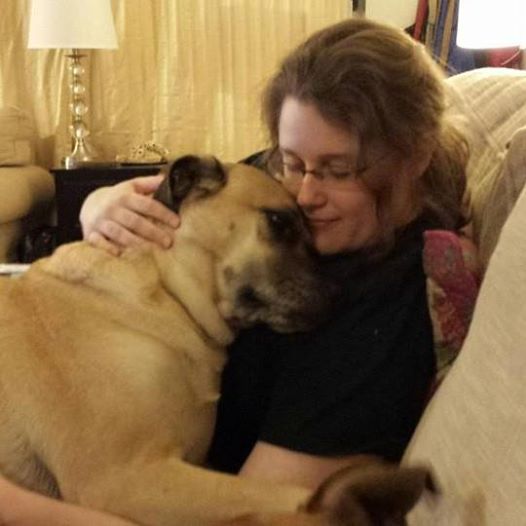
I also miss scratching and massaging my dogs, but I cannot talk about that too much without getting sad. I pet them with my knuckles now that my fingers curl in. I hope they can feel that I love them. Honestly, though, I am afraid they won’t feel my affection and will grow away from me. My hands were our only common language.
13872779_10100918527914567_2980573773885241777_n

Hands: Part 1

If I had full use of my hands again, the first thing I would do is hold Evan’s hand. It is impossible to interlace our fingers when mine are so weak and wobbly. I also miss my hands as instruments of creativity. I used to sketch, paint, and even sculpt. I wanted to pursue my pottery, especially raku technique, but I did not make time for that endeavor while I was healthy. Teaching took up most of my time, not that I regret the hours I spent grading papers and planning lessons. I am lucky to have had a career I loved so dearly.

If I had strong fingers, I would sew. I loved sewing aprons for my mom and gifts for family and friends. Of course, the major advantage of strong fingers (in my opinion as a writer) is being able to type. I am grateful for the eye gaze technology that allows me to write without relying on my hands, but I miss the speed of typing, particularly when my ideas are flowing like rapids over jagged rocks, desperate to get out.

I would also learn new skills. Mainly, I would want to learn to play an instrument. I love watching Evan play the guitar, and I think it would be wonderful to accompany him somehow, probably on the piano. The piano was special to my Grandma Rosemary, and I still remember her teaching me a few basic melodies.

I might miss my hands more than my legs. Hands are so quintessentially human. I am isolated from displaying affection when my fingers curl in on themselves like claws. I scramble to find new creative outlets and accept that some art forms are simply lost to me.

img_0009

The Blue Room

4

When I was diagnosed, I choked on fear beyond any I had ever known. It easily surpassed even the terror I felt when I was raped and almost murdered. At least then there was a chance I could make it out alive. At the moment of diagnosis, blood rushed to my face, making my skin burn. My ears rang, both deafening me and heightening my senses so I could hear the doctor’s tears. A black cloud ate up the edges of my vision, and I thought, “This is death. It’s black and nothing and it’s coming for me now.” I had just enough time to notice the absence of Jesus in the hungry darkness when I saw my chiIdhood Christmas tree in perfect detail. I hoped dearly to see it again.

Imagine, all of that in a matter of seconds.

Then, I collapsed against Evan, and an umbrella came over us. I thought of nothing but him as we sobbed  together until we were nauseous. My mind spun on this loop: “I don’t want to leave Evan. He will be so sad to lose me. I can’t let this happen to us.” That train of thought possessed me. It still does. I can’t conceive of being separated from Evan. It shouldn’t be allowed. Doesn’t God know that I love Evan more than any human has ever loved another?

But a person can’t feel such an intensity of horror forever. That alone would be fatal.

This is how I live now. The darker feelings come in small chunks, so I am able to understand them as singular dead leaves moving along, unable to do me any real harm. I give them space in my river until they drift on, leaving the water clear. In the clean river, I am strong  enough to hope.

Still, sometimes when I lay in the dark waiting for sleep, I remember the blue cinderblock room where I heard the news, and I feel like I never truly left. It has become both my Hell and my home.

Fortune’s Fool

When I was sixteen, a fortune teller at a fair predicted I would meet and fall in love with a man who would physically take care of me. At the time, I didn’t understand what she could possibly mean. Would I rely on my husband for money? I was hungry for independence and therefore a bit insulted, but most of all, I was bewildered. I needed more time with the fortune teller in her enchanting red silk tent, but she looked pointedly at her watch, then tapped the cash tray. My empty wallet made me unwelcome.

When I asked about the man I would marry at the beginning of our session, I did not imagine the ten minutes I paid for would pass so quickly and end so mysteriously. I wondered about her words for more than a decade, right up until my ALS diagnosis twelve years later. That day, I finally got the answer I sought. Doors slammed in my face. All around, clock needles spun backward. My end crept forward in every shadow.

Now, I rely on Evan to bathe, feed, and dress me, to keep me steady when I use my walker in the bathroom, even to wipe me after I use the toilet. He holds all the crumbling pieces of my body tight in his hands, as though trying to keep them safe until the miracle pill that can put me back together again finally arrives. My marriage looks nothing like it did when we were twenty-one or twenty-five, or even last year. Playtime is over, and we struggle daily to survive.

However, I realized as Evan delivered medication into my body via my brand new feeding tube, that what really matters remains unbroken. Even after all we’ve lost, he still loves me, and I will always love him. That knowledge is the bedrock of my existence, and it has yet to crack. Together, we chase happiness through a tangle of feed lines and IVs, not ready to surrender to how we live now. Side by side, with white knuckles and bloody nails, we crawl forward.

Benvolio: Romeo, away, be gone! Stand not amaz’d, the Prince will doom thee death if thou art taken. Hence be gone, away!

Romeo: O, I am fortune’s fool!

Romeo And Juliet Act 3, scene 1, 132–136

Demon in My View

Photo by Bob Clark on Pexels.com

“I have not been

as others were –

I have not seen

as others saw…

When the rest of Heaven was blue

of a demon in my view.”

Edgar Allan Poe, “Alone”

I’m so sick of ALS. It is hitting me once again that this is my life, and even when I’m tired or sad, I won’t get a break. ALS will not stop until it kills me or a cure is found. The clock is ticking, and my murderer is stepping on my shadow.

Leaves in My River, Stars in My Sky

I hate crying – it’s an uncontrollable language of pain, and I lack enough control as it is – but I was crying tonight. I’ve heard that no single emotion is inherently good or bad. We should acknowledge them all, pick each up like a leaf from a stream, think, “It’s just sadness,” then put it back down and let the water take it away. However, I like to pick up the Sadness Leaf, crush it, and bury it in the dirt. Out of sight, out of mind.

Scrolling through my Facebook feed after dinner, I found myself thinking about all the people who stopped speaking to me after my diagnosis, and tears, undeniable evidence of sadness, came. Mostly I stay positive. My doctor and I believe I will survive long enough for a treatment or cure to be developed. That possibility and the love of my friends and family keep me fighting. Still, the deafening silence from people I grew up with, celebrated holidays and birthdays with, listened to when they were troubled… it hurts enough to make my throat clench and my eyes sting. It starts a rush of unwelcome memories of staying up late on the phone, talking a friend through a divorce. Then I recall walking down the aisle preceded by bridesmaids who have faded like ghosts from my life, existing for me now only in photographs. Friends I traveled the world with might as well have stayed on the other side of the ocean; they are that distant from me. These people I loved drifted away like debris on a beach in the first high tide after a tempest.

In the quiet after the storm of my diagnosis, my old life washed away, and I learned the truth about those I love. People who are far away or have been out of touch resurface, and I realized that for all the people nearby who are too weak to support me, there are others, scattered like stars on a winter night, who have been glowing for me this whole time.

There is the college friend I met so many years ago and now only speak with occasionally, though we once talked every day. He was the one to hear the news and call, crying. No words, just sobbing because that said it all. I cried under cover of his tears, safe because I couldn’t hear my own.

Then there is the woman I knew only for one summer back in California when together we learned to cook like adults, follow a recipe, peel a mango. She flew to me in Oregon, made her super secret special cake, and promised to stay with me until the end and hold my husband’s hand at the funeral, whenever it may come.

Seven years ago, I met a girl in a karaoke lounge in DC, and we sang Britney Spears (ironically, if that’s what you need to believe to keep reading this post). We both moved, sometimes to the same cities. We campaigned together, hit all the vegan restaurants we could find, and lounged in parks with a pile of books. She stayed up late for a month after my diagnosis to answer my desperate 2 AM phone calls. She’s coming to visit this weekend.

Last month, my in-laws moved across the country to live five minutes away. My mother-in-law feeds me pills in yogurt so I don’t choke on water and helps me clean my teeth. Then there’s my father-in-law, who brings me desserts several times a week to keep my weight up and once spent a whole day assembling my hospital bed.

And last in this post but not in my life, the aunt and uncle who surprised me by sending a box full of starfish. They live at the beach where my family went on vacations. They must remember how I couldn’t end a week at the beach without bringing a starfish home. I brought a starfish with me when my husband and I moved 3,000 miles away to remind me of my childhood, but one night Malka ate it for reasons we cannot fathom. Receiving these new starfish reminded me that I and my precious past are not forgotten.

Allowing my mind to linger on these winter stars introduces some happiness and gratitude to my swirling thoughts. They are more leaves in my river, floating alongside and softly nudging the painful ones. They make it easier to unclench the fist I made around that first sour leaf, to let it go and trail my fingers in the water to feel whatever the current holds. It drifts on, benign and unremarkable.

After all, it’s just sadness.

Cathedrals: On Losing My Voice

“In my mind I am eloquent; I can climb intricate scaffolds of words to reach the highest cathedral ceilings and paint my thoughts. But when I open my mouth, everything collapses.”

― Isaac Marion, Warm Bodies

A Wind in the Door

Only two more days until my Tobii Dynavox comes. I cannot wrap my head around this. I’m getting back the ability to text and talk on the phone. I will be able to write emails and blog posts at a more normal pace (right now, my fingers are a total mess, so I type like a snail).

Change is in the air, a wind is in the door. My voice is slipping away, and technology to replace it is stepping in. The arrival of my Tobii Dynavox will be an emotional time; I’m scared I will cry.


“I wish human beings couldn’t have feelings. I am having feelings. They hurt.”
― Madeleine L’Engle, A Wind in the Door

A Pashmina For My Appendix

Today I bought shoes for the first time since my diagnosis. It was also the first time I bought shoes I would not actually wear for walking. My new sandals will just serve as a barrier between the soles of my feet and my wheelchair’s foot plates. No more worries about arch support or gaping at my heel. No test runs to make sure the shoe doesn’t rub the small bulge on my toe where I once snapped it during ballet. Shopping for shoes was like getting a frivolous accessory for a vestigial organ, a pashmina for my appendix. It was a novel experience, but ultimately too bizarre and sad to look forward to repeating.