My FDA Advisory Committee NurOwn Statement

Dear Drs. Califf and Marks,

I am a young woman living with ALS, and I am writing in strong support of the approval of the ALS treatment debamestrocel, which has proven to be both safe and effective in clinical trials.

ALS is a brutal enemy. This equal opportunity killer destroys the nerves that allow us to move, speak, eat, swallow, and eventually breathe. It is 100% fatal and has no cure. It can strike anyone at any time.

When I was diagnosed with ALS at age 28 in 2015, I lost everything. My body, without warning or reason, turned on me, and that meant the end of so much. My career as a 5th grade English teacher and dreams of motherhood and growing old with my husband were all swept away like sand when I believed they were stone.

Let me paint you a picture of my life with ALS. My day starts with 40 minutes of breathing treatments to prevent infection in my lungs that leave me feeling like I’m suffocating. We stop when my oxygen drops to 92.

I’m on a ventilator which is supposed to provide me with full, even breaths, but if the settings are even slightly off, it either doesn’t provide me with enough air or pushes too much too fast, forcing me to hyperventilate and pass out.

I survive on a feeding tube and haven’t enjoyed real food in 7 years. We start my “food,” a beige nutrition solution that comes in cartons, after my breathing treatment. It’s delivered to me through a pump over the course of 20 hours, often leaving me nauseous.

Because I am on a ventilator, I can’t produce sound, not even a whimper when I’m in pain. I communicate with a device called a Tobii that uses eye gaze technology. I am actually typing this letter with my eyes.

Why not write to you with my hands like a healthy person? I forgot to mention that because of ALS, I’m a quadriplegic, meaning I can only move my face. I miss being able to touch. I haven’t hugged my husband Evan in 6 years. I can’t even hold his hand. I’m totally paralyzed and totally dependent on others to meet my every need.

Imagine you can’t scratch yourself when you’re itchy, can’t adjust the thermostat or even cover yourself when you’re cold, can’t clean yourself after using the toilet. That’s my life. ALS has stripped me of my independence. I’m utterly helpless without others, and I am nothing without my machines.

The ALSFRS-R is a tool to attempt to quantify how ALS is affecting a person. A 1 score increase could be the difference between choking and eating normally or requiring a walker and walking with a minor foot drop.

The ALSFRS-R is imperfect at best. One person can have a score of 37 and be walking and breathing normally but have their hands, swallow, and voice impaired, while another person with a score of 37 could have significant shortness of breath and require a power wheelchair but have full function of their voice, swallow, and hands. It is not an accurate representation of every individual’s unique case or the changes that are occurring.

My 2015 score was 34, and my 2021 score was 1. Does a score of 1 accurately reflect me? I still communicate, live, love, smile. I have rich friendships and a healthy, passionate marriage. I’m a talented writer who raises awareness of the reality of ALS by blogging (howilivewithals.com). A score of 1 is completely unfair attempt to display ME.

Debamestrocel has achieved remarkable feats in clinical trials, including maintaining and even increasing ALSFRS-R points. Every point matters in preserving an individual’s independence and dignity. Debamestrocel also improved CSF biomarkers in ALS. No other drug has accomplished this. The benefit to those in the early phases of ALS is clear in P3 trials.

Debamestrocel is a beacon of hope to members of the ALS community, and with rapid disease progression ending in death within an average of 2 – 5 years, we don’t have the luxury of time to wait for treatments.

Give those in the early stages of ALS a chance to have more years on earth and make precious memories with their loved ones. Approve debamestrocel.

Sincerely,
Rachel Doboga

You’re Invited!

Consider this your invitation to write your own statement urging the FDA to approve NurOwn / debamestrocel! The deadline is September 20th, so get moving! The organization I AM ALS has created a wonderful guide to writing a powerful statement. Check it out! And remember, you MUST include the following:

Docket No. FDA-2023-N-2608 for Cellular, Tissue, and Gene Therapies Advisory Committee; Notice of Meeting; Establishment of a Public Docket; Request for Comments

Can AI Voice Cloning Be Used For Good?

Photo by Polina Kovaleva on Pexels.com

I’m pleased to present the link to the story for which I was recently interviewed, “Can AI Voice Cloning Be Used For Good?” by Kaleef Starks, Mark Armendariz-Gonzales, and Clera Rodrigues. The interview focused on the changes ALS has caused in my communication, as well as my experience with AI voice cloning and preservation. To read my full interview, click the book icon on the left. It’s under the heading, “Rachel’s Story.” Enjoy reading!

Eight Years In…

Photo by Hakan Erenler on Pexels.com

Eight years ago on June 8th, I was diagnosed with ALS. At diagnosis, I was given 2 – 5 years to live. We all are. I was just 28 years old.

After my diagnosis, I immediately said goodbye because that’s what I was told to do. I was told there is no cure for the monster that had taken over my body, my life. I posted something on Facebook to the effect of, “I’ve just been diagnosed with ALS. Thank you all for being a part of my life.” I didn’t know there were other options, that even without a cure I could fight.

My fantastic ALS clinic connected me with the local chapter of the ALS Association and suddenly I had a power wheelchair, a Tobii eye gaze computer, and a cough assist machine, and I was trained to use it all. I had many long conversations with my neurologist, pulmonologist, social workers, husband, and family, and decided to go on a ventilator when the time came. I’m now a bedbound quadriplegic on life support and survive on a feeding tube. I’m very lucky because I live at home despite my high needs. My husband Evan works tirelessly, seeing to my every need. He is the reason I fight. I would do anything to stay by his side.

When I was diagnosed, we were about to start a family. I can’t have kids so we were researching adoption agencies. We decided to adopt siblings because they are hard to place. I even made a Pinterest board with resources for adoption and raising creative, resilient, grateful, vegetarian children. I also had a list of 27 parenting books we were planning to read together. We were going to be READY, but you know what they say about the best laid plans…

Eight years in, I’m starting to forget what it was like to speak and move. I guess it’s for the best since I will never talk or walk again. I remember certain things, though, like playing Who’s the Judge with my family at the kitchen table after dinner. We would sit in a circle and when it was your turn, you said a silly phrase in an even sillier accent. Everyone else had their eyes closed and would try to guess who the speaker was. Looking back, it was a ridiculous game. It was only my parents, sister, and me so it was easy to tell who had spoken by location alone. Plus, we always took turns in the same order. We all had fun, though.

I remember the first time I spoke Russian in Russia and someone understood me. It was like the best magic trick ever. My first words were to the taxi driver bringing me from the airport to my new home for the summer.

“I’m afraid,” I told him.

“Why?” he asked.

I explained I was worried the door to the apartment wouldn’t open. He promised to stay until I got inside. The magic trick worked.

I remember dancing with Evan with my Walker between us in the living room, his strong hands firm on my hips keeping me safe as we swayed softly, softly to Frank Sinatra. No more swing dancing for us. In our first Ice Bucket Challenge, Evan said, “I’m doing this so I can dance with my wife again!”

I remember dancing with dad on his feet in a living room across the country 30 years ago, usually to something loud like Eric Clapton. “Layla” was my favorite because every time it came to the part where Eric Clapton sings, “You got me on my knees Layla!” dad would set me down and fall on his knees in front of me.

These losses don’t hurt anymore unless I focus on precise moments I’m able to fish out of the murky depths of my memory. I have learned better than to do that. They only ache now.

I miss my old self, the creative, playful teacher, the fossil hunter, the singer, the traveler. I’m reminded of the lyrics to “Summertime Sadness” by Lana del Rey: “Think I’ll miss you forever like the stars miss the sun in the morning sky… Even if you’re gone I’m gonna drive!”

Getting Back My Voice?

3

2

This news is both moving and a profound reason for hope! When I was diagnosed three years ago, voice banking would have taken eight hours, and I simply didn’t have the strength – or money – for such an endeavor. As you will see in the video,141136 this company was able to recreate this man’s voice with only three hours of recording. Maybe one day, my half hour of recording will be enough to get my voice back!

Summer Dreams

4

Something about spending time on a covered porch always leads me reminiscing and daydreaming. As the rain clears to make room for the summer sun, I spend hours out there, watching my dogs play and letting my mind float on the afternoon breeze, I remember, and I plan.

This beautiful weather makes me miss canoeing with Evan terribly. The sound of the water as our paddles slid through the gentle waves slowed my thoughts so I could exist in that moment, working in perfect synchronization with Evan. I especially loved our sunset excursions when the world we knew drifted off to sleep and another secret world began to stir, a nocturnal kingdom we could only glimpse before we lost the light and our way.

When I am cured, Evan and I will return right away to the water. We will buy a red canoe and name it Carlos, and he will take us on dozens of new adventures.

The other activity I am missing is something I only did once. I was shy and nervous, so I didn’t get up the nerve to try karaoke until rather late in the game. When I finally sang into that microphone, though, I was hooked. I especially loved singing duets with Evan (he makes everything at least ten times more fun). When I have my voice back, I am going to hit every karaoke bar in town!

Three Dreams and A Dragon

When I was thirteen, I bought a small, blue, canvas-bound book whose title, scrawled in loopy silver script, read, “The Interpretation of Dreams.” I purchased it because every morning, I awoke with vivid memories of three, sometimes four, dreams. About half of them were nightmares, but they didn’t trouble me as much as what I called the Sagas. In those dreams, I lived entire lives, and when I woke up and realized that none of it was real, the resulting devastation was almost as intense as if I just lost actual friends, a husband, children. I hoped that I would find answers about what the Sagas meant and achieve peace by way of the knowledge.

I never found my answers; when I started taking anti-depressants at age fourteen, the Sagas disappeared, so I abandoned my research. However, the nightmares began to run rampant.

Lately, my nightmares have been especially painful. I have three that take turns playing in my nocturnal theater. First, I dream that fierce predators escape from the zoo, lurking the city’s streets, lying in wait for unsuspecting humans to cross their path. Unfortunately, I’m the only one who knows this, so it falls to me to protect my husband and sister even though I don’t have a single weapon.

Next up, I awake on a dark beach. I lay on the rough sand, utterly confused by my surroundings. Then a pair of hands reach down to help me up. I realize too late that they belong to my rapist. Raising a hand to caress my cheek, he says, “We’re the last people on earth. It’s just us. Now we can be together forever.” It’s then that I notice I’m wearing my wedding dress.

The worst dream starts before I even fall asleep. As I drift, memories of the words of my last Lower School Director and the Head of School echo in my head…

“Your students are bored.”

“Their parents lack confidence in you.”

“Maybe your personality is the issue. Go observe the Spanish teacher. Try to be like her.”

“You lack presence in the classroom.”

“Have you considered being a librarian? Then you won’t work with children every day, and you can be around those books you love so much.”

“You’re too academic.”

“Try not to look so frail. Stop hunching over your cane.”

“Are you really teaching if the kids aren’t learning? ”

“Fifth grade is an important year, and we need a teacher so fantastic that families don’t even think of transferring to another school for sixth grade. There are five families thinking of leaving – you’re not a strong enough teacher.”

“I’ve been disappointed in you from day one.”

Then, when sleep finally comes, I am teaching in a classroom with glass walls. I don’t have a lesson plan, and when I see the Lower School Director and the Head of School watching me, I panic, making one stupid mistake after another, knowing each is a nail in my coffin. The dream fades when memory wipes away the fear and reminds me that it’s over now. I survived being kicked to the curb, and – awful as it was to end my career on a low note – they can’t hurt me anymore.

I don’t need the book to pick up the themes these dreams share; in each one, I am caught off guard and helpless. That is the essence of ALS. No one is prepared for the diagnosis (most cases can’t be tied to a family history, and lifestyle seems completely irrelevant). To make matters worse, the diagnosis comes with a decree of helplessness since there isn’t a thing you can do to fight back. I’m guessing that I am reliving the trauma of the diagnosis, but I don’t think it has to continue.

I recently realized that I am not helpless, not by a long shot. How many pieces have I written detailing my commitment to my range of motion exercises, my eagerness to participate in drug trials 135164, my openness to new medications and protocols 136165 to manage my symptoms? I use the cough assist 137166 to keep my lungs strong, my feeding tube to maintain proper nutrition and hydration, and my tobii to prepare for when I lose my ability to speak. I am not sitting on the sidelines watching this monster consume me. I am fighting the dragon with a small dagger, slashing and slicing bit by bit until I bleed it dry. From now on, I will hold this gruesome, glorious image in my mind as I fall asleep. Maybe then I’ll dream of slaying the beast.

Learning Helplessness

Today while out on a (st)roll, I witnessed a toddler run out into the street in front of a car. I was unable to do what every molecule in me demanded: race to the boy and snatch him up out of harm’s way. I couldn’t even scream in horror or point and shout so a neighbor would notice and intervene. I could only watch.

Luckily, just as the child reached the middle of the road, the boy’s mother realized he had wandered off and saved him.

I thought by now I knew what it is to be helpless. When I fall, I can’t get up. I am not able to feed, bathe, or dress myself. I can’t even be left alone for more than one hour. I had no idea, though.

Now, I know.

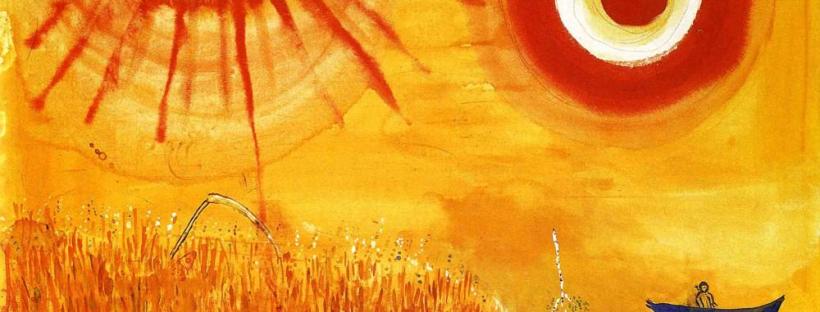
Image credit – Marc Chagall’s “Un champ de ble apres-midi d’un ete”


A Lesson on Joy

In the movie adaptation of my life, the climactic scene would go like this: the camera slowly sweeps up to where I am snuggling into a warm plaid blanket on a rustic porch.  The sun peeks out from where it slept behind the mountain range. The soft light on my face shows I’m at peace. I struggled throughout the whole movie with how to carry on living, but last night I found the trick. My friends pushed my wheelchair out into the meadow behind my sister’s cabin, and we stayed up all night watching the stars, singing, laughing, and telling secrets. I know now that this is the key: live in the moment, live for today, and let no adventure pass me by until I close my eyes for the last time.

That’s what dying people are supposed to do, right? It’s our bittersweet version of happily ever after.

9224,-Teton-Barn-and-Mauve-Dawn,-30x40

Hanselmann Photography

For me, though, there was no mountain cabin, no midnight epiphany. For the longest time, there was only the looming specter of my death. When I was first diagnosed with ALS, I described the doctor telling me the news by saying, “He told me I’m dying.” I used to get those two things mixed up: having ALS and dying. They do sound the same. After all, there is currently no cure or treatment for this ruthless disease. Immediately after diagnosis, I planned everything from who would get my beloved cameo necklace passed down from my great grandmother to the type of funeral I want. I imagine a ceremony around a sapling which my family and friends can visit and tend to as it grows into a memory tree. I hoped my loved ones would picnic there, and children would climb my branches.

biodegradable-burial-pod-memory-forest-capsula-mundi-3

Of course, not all of my death thoughts were so serene. The prospect of dying young fueled what became an obsession with fading into a distant memory as my loved ones grow old without me. I worried most about what I would become to my husband, Evan. I imagined being a brief chapter of his life before he meets the woman who will be the main act, the mother of his children. She will succeed where I failed, giving him the family and future he deserves, transforming me into a tragic footnote in his biography. With my mind drenched in such excruciating fears, how could I surrender to the beauty of the present?

A series of fortunate events saved me from despair. First, we moved to Portland, where I received the exact kind of care I hoped for at my new ALS clinic. I now work with a creative, emotionally intelligent doctor who is full of hope regarding treatments currently being tested. She immediately empowered me by involving me in one such trial. Finally, I was doing something to fight back, and I dared to dream that the end of my story might not be written on a tombstone.

Then, a few months later, I found the next rung of the ladder that I would climb towards joy. ALS Awareness Month crept in, and a flurry of fundraising activity swept across my Facebook feed. Guilt pressed down hard on my shoulders; I was the one with ALS, but my family was doing all the advocacy work. As a last minute attempt to get involved, I decided to write a little note on Facebook every day about my life with ALS. I didn’t expect to generate much interest, especially since I wasn’t sure how much had to say on the subject. Flash forward three days, and I was pouring my heart out to a shockingly large and invested audience. I became enamored of power those posts gave me over my experience. That power, just like the power I gained from the drug trial, gave me the bravery to fight like never before. I dove into fundraising for the ALS Association, and my doctor and I collaborated with ALS Worldwide to learn new ways to preserve my speech, strength, and mobility. As my hope blossomed, I realized I couldn’t honestly fight for a cure without spending at least as much time imagining my life after ALS as I had spent fixated on my death.

I came to understand that joy will remain a distant dream if a person can’t give equal head space to the best and worst outcomes.

Real, lasting joy pumped from my heart to every inch of my failing body when I gave myself permission to dream. Now, I imagine that Evan and I will make up for all the years we have spent bound to our home and hospital by renovating an Airstream trailer and roaming all over the country, exploring national parks, chasing northern lights, and following music festivals. I will return to writing novels because the miracle of a cure will mean that a blog about ALS will be unnecessary. Evan will play guitar in the evenings, and I’ll sing along like I used to. Everything will be beautiful, and nothing will hurt.

orvis-airstream

A few months after I started my blog, I got a feeding tube. Lying on table looking at the distant ceiling of the operating room, it occurred to me that this would be the first scar ALS left on my body. I got sad thinking about how I would never get rid of it, even if one day I no longer needed the feeding tube. But then, I thought of myself leaning out the window of the car on a sunny day with hundreds of miles ahead of me, Evan looking handsome in the driver’s seat,  our Airstream trailing behind us, glittering in the sun like a mermaid tail, and I didn’t mind a small scar at all. Some day, it will be the only reminder of what I suffered, and should I ever get scared embarking on my new adventure, I can look to the hole sewn up right beneath my heart and know I will survive.

Cathedrals: On Losing My Voice

“In my mind I am eloquent; I can climb intricate scaffolds of words to reach the highest cathedral ceilings and paint my thoughts. But when I open my mouth, everything collapses.”

― Isaac Marion, Warm Bodies