If my dream of collecting and expanding my best essays and turning them into a book ever becomes a reality, there are a few new topics I am dying to write about that are just too involved for my blog. I would devote a whole chapter to the ways ALS has changed my understanding of gender, and then another chapter on how the changes ALS has wrought upon my body fit into my lifelong, desperate quest for beauty.
Today while out on a (st)roll, I witnessed a toddler run out into the street in front of a car. I was unable to do what every molecule in me demanded: race to the boy and snatch him up out of harm’s way. I couldn’t even scream in horror or point and shout so a neighbor would notice and intervene. I could only watch.
Luckily, just as the child reached the middle of the road, the boy’s mother realized he had wandered off and saved him.
I thought by now I knew what it is to be helpless. When I fall, I can’t get up. I am not able to feed, bathe, or dress myself. I can’t even be left alone for more than one hour. I had no idea, though.
Now, I know.
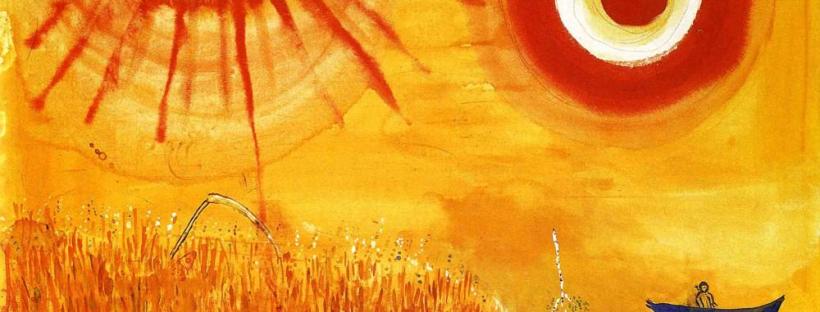
Image credit – Marc Chagall’s “Un champ de ble apres-midi d’un ete”
In the movie adaptation of my life, the climactic scene would go like this: the camera slowly sweeps up to where I am snuggling into a warm plaid blanket on a rustic porch. The sun peeks out from where it slept behind the mountain range. The soft light on my face shows I’m at peace. I struggled throughout the whole movie with how to carry on living, but last night I found the trick. My friends pushed my wheelchair out into the meadow behind my sister’s cabin, and we stayed up all night watching the stars, singing, laughing, and telling secrets. I know now that this is the key: live in the moment, live for today, and let no adventure pass me by until I close my eyes for the last time.
That’s what dying people are supposed to do, right? It’s our bittersweet version of happily ever after.
Hanselmann Photography
For me, though, there was no mountain cabin, no midnight epiphany. For the longest time, there was only the looming specter of my death. When I was first diagnosed with ALS, I described the doctor telling me the news by saying, “He told me I’m dying.” I used to get those two things mixed up: having ALS and dying. They do sound the same. After all, there is currently no cure or treatment for this ruthless disease. Immediately after diagnosis, I planned everything from who would get my beloved cameo necklace passed down from my great grandmother to the type of funeral I want. I imagine a ceremony around a sapling which my family and friends can visit and tend to as it grows into a memory tree. I hoped my loved ones would picnic there, and children would climb my branches.
Of course, not all of my death thoughts were so serene. The prospect of dying young fueled what became an obsession with fading into a distant memory as my loved ones grow old without me. I worried most about what I would become to my husband, Evan. I imagined being a brief chapter of his life before he meets the woman who will be the main act, the mother of his children. She will succeed where I failed, giving him the family and future he deserves, transforming me into a tragic footnote in his biography. With my mind drenched in such excruciating fears, how could I surrender to the beauty of the present?
A series of fortunate events saved me from despair. First, we moved to Portland, where I received the exact kind of care I hoped for at my new ALS clinic. I now work with a creative, emotionally intelligent doctor who is full of hope regarding treatments currently being tested. She immediately empowered me by involving me in one such trial. Finally, I was doing something to fight back, and I dared to dream that the end of my story might not be written on a tombstone.
Then, a few months later, I found the next rung of the ladder that I would climb towards joy. ALS Awareness Month crept in, and a flurry of fundraising activity swept across my Facebook feed. Guilt pressed down hard on my shoulders; I was the one with ALS, but my family was doing all the advocacy work. As a last minute attempt to get involved, I decided to write a little note on Facebook every day about my life with ALS. I didn’t expect to generate much interest, especially since I wasn’t sure how much had to say on the subject. Flash forward three days, and I was pouring my heart out to a shockingly large and invested audience. I became enamored of power those posts gave me over my experience. That power, just like the power I gained from the drug trial, gave me the bravery to fight like never before. I dove into fundraising for the ALS Association, and my doctor and I collaborated with ALS Worldwide to learn new ways to preserve my speech, strength, and mobility. As my hope blossomed, I realized I couldn’t honestly fight for a cure without spending at least as much time imagining my life after ALS as I had spent fixated on my death.
I came to understand that joy will remain a distant dream if a person can’t give equal head space to the best and worst outcomes.
Real, lasting joy pumped from my heart to every inch of my failing body when I gave myself permission to dream. Now, I imagine that Evan and I will make up for all the years we have spent bound to our home and hospital by renovating an Airstream trailer and roaming all over the country, exploring national parks, chasing northern lights, and following music festivals. I will return to writing novels because the miracle of a cure will mean that a blog about ALS will be unnecessary. Evan will play guitar in the evenings, and I’ll sing along like I used to. Everything will be beautiful, and nothing will hurt.
A few months after I started my blog, I got a feeding tube. Lying on table looking at the distant ceiling of the operating room, it occurred to me that this would be the first scar ALS left on my body. I got sad thinking about how I would never get rid of it, even if one day I no longer needed the feeding tube. But then, I thought of myself leaning out the window of the car on a sunny day with hundreds of miles ahead of me, Evan looking handsome in the driver’s seat, our Airstream trailing behind us, glittering in the sun like a mermaid tail, and I didn’t mind a small scar at all. Some day, it will be the only reminder of what I suffered, and should I ever get scared embarking on my new adventure, I can look to the hole sewn up right beneath my heart and know I will survive.
I am in a painfully bright room. White walls, white cabinets, white floor, all illuminated by fluorescent lighting. Evan is to my right, seated in a black plastic chair, left leg on his right knee, hand on his ankle. He is several days behind on his beard maintenance, and he keeps running his hand through his hair, a sign that he is in a thoughtful frame of mind. I tune in to what his moving lips are saying:
“… Pattern seems to be a few days of constipation, then stomach cramps and a painful bowel movement. ”
He is looking straight ahead, and I follow his gaze to a young woman, blond and stylish, sitting at a small portable desk. She takes notes as Evan speaks. When he finishes, she looks up from her stack of paper, saying, “It sounds like we should go back to four ounces of prune juice every day.” Evan nods.
It takes me a minute to understand what is happening. I took two Vicodin, two Clonazepam, and a capsule stuffed with Marijuana last night, so I feel like a sleep walker, disconnected from reality just enough to confuse it with a dream. Now I am waking up, though, and my reality jars me.
“What do you think, Rachel?” the woman asks.
I think that I have no idea how or why I’m here, that I’m in an alien world where we track the myriad ways my body is self-destructing. I think that I have been in this Hell so long, I don’t even notice how awful, unnatural, unfair it is because humans adjust to anything in the name of survival, for better or worse, but that’s also the key to happiness.
However, that isn’t what she wants to know, so I file the horror away in the drawer labeled “To Cry About Later ” that is so full, I have to squeeze the paper in.
I paste on a smile and say, “Prune juice sounds fine.”
Agent Fox Mulder, the protagonist of the cult classic TV show “The X-Files”, is on a mission born of personal tragedy. He is obsessed with hunting down UFOs in order to find answers about extraterrestrials because as a child he witnessed his sister being abducted by aliens. His search for answers is relentless even though science hasn’t caught up with his belief that “the truth is out there.” Every time he investigates a case that seems bound to result in revelation, he gleans only enough scraps of information to keep from losing faith. Is this starting to sound familiar?
Those of us who have been personally affected by ALS have a similarly dogged commitment to searching for the truth about a disease nearly as mysterious as ETs – one without a known cause or cure. The countless studies made possible by extraordinary fundraising efforts such as the Ice Bucket Challenge are providing glimpses into the shadows shrouding ALS. Sometimes I wonder, though, when the revelation I am waiting for will finally come.
Like my favorite FBI character, faith keeps me going. Many people think that you either have faith or you don’t, that believing is an ability we can’t control, like a natural talent for music or art. However, I experience faith in the dedication and brilliance of the scientists working to slay this dragon is a decision. Agent Mulder is famous for his line, “I want to believe.” Being impatient and afraid are inevitable, but letting those emotions overwhelm faith is a choice. I want to believe, and so I decide to, again and again, for as long as it takes.
Lately, I feel like the little girl in this music video – that I have to put on a cape and mask just to face the world and my increasingly isolated place within it. Of course, that’s not a healthy or sustainable way to live, but I try all the same. Perhaps I try because I prefer the dull ache of wearing my cloak to the sting of vulnerability that comes with allowing the whole world to see my wounds. I doubt that I am alone in this, so maybe simply sharing the feeling will be helpful even if I can’t expose the words written on my back for fear that they are true.
Tonight, after reading and listening to a podcast for a few hours, I felt stir-crazy from sitting for so long. I needed to get up. Specifically, I felt like trying out the Movements I saw on the Netflix series “The OA”. I was just about to do that when I remembered I could not get up.
This is not the first time I have forgotten my limits. Sometimes when I wake up, I plan on walking to the closet to pick out my clothing. It takes a few seconds of trying to swing my legs the edge of the hospital bed (how I miss the ankle-aching cold of morning floorboards beneath my bare feet!) to remember I can’t walk that far.
Perhaps I forget because I can walk in my dreams. Every time. However, even in my dreams, I am aware that walking is unusual for me. Usually, I dream that I am walking and then suddenly remember that, like Cinderella and her pumpkin and rag dress, my legs will return to being essentially useless by midnight. Sometimes, I even feel them weaken and my knees buckle. Even in my dreams, I cannot escape my disease.
Shrugging off the crushing weight of realizing my disability anew, I force myself to forget that I am stuck sitting and will continue sitting for the rest of my life, or until a cure is found. I look at Evan and my pets and try to let the feeling of being loved overwhelm the feeling of being trapped.
I have a serious case of drug trial FOMO (fear of missing out). I just completed my year-long Tirasemtiv drug trial. I don’t know whether I was on the placebo or active drug. However, I have been invited to join the open-label extension of the clinical trial. That would mean I definitely would have an active dose. Meanwhile, the company that created Tirasemtiv is applying for FDA approval at this very moment. I take all of this information to mean that the medication worked: it preserved strength in the diaphragm, preventing a decline in lung function. In that case, being in the open-label trial is a great opportunity because I will have the drug immediately and keep my lungs from deteriorating.
There is a complication, though. If I join the open-label extension, I will take Tirasemtiv for the rest of my life as a way to research long-term safety of the medication. The open-label extension also requires that I not participate in any other trials. There is a trial coming up in April that I have been excited about, but is it promising enough to give up Tirasemtiv? It would help if I knew how well Tirasemtiv works, but I don’t think that is clear yet, even to the research team. I do know that throughout the study, my lung function did not decline at all. So is Tirasemtiv the safe bet?
Reading the news, it seems that possible cures are being found more and more quickly. Tirasemtiv is a treatment, not a cure. Let’s hop back to the experiment I mentioned that will take place in April. That one might be a cure. How can I turn my back on that? It seems like if I play it safe, I could be excluding myself from something miraculous. On the other hand, if the drug trial in April fails, I will have given up lung protection for nothing.
The original plan was to protect my lungs at all costs no matter the collateral damage, and that way, when the cure comes, my vital functions will be strong enough for me to properly heal. And what is this collateral damage? It is pain. For the past year, I have chosen pain in order to be in this trial. Being on Tirasemtiv means I cannot safely take Zanaflex, the medication that completely erases my spasms and muscle cramps. Instead, I am on a cocktail of a narcotic (Vicodin), a controlled substance anxiety medication called Clonazepam, and the muscle relaxer Baclofen. Evan also massages Bengay all over my limbs when my cramps get bad. Plus, I have a sizeable stash of medical marijuana (60% CBD) that is also working to loosen my joints and muscles. That is the price of my involvement in the study, and I will continue to pay it if I join open-label.
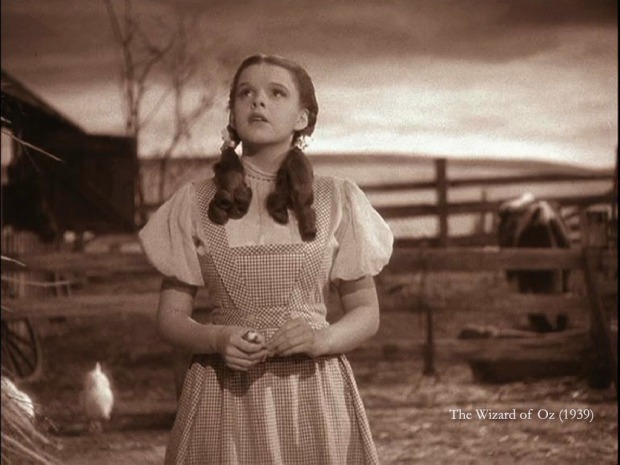
Just like the structure of this narrative has spiraled into dizzying circles, my thoughts are a tornado. It hops throughout my imagination, stirring up awful and wonderful scenarios. It rips through my sleep, and there is no seller with Aunty Em waiting to make it all better. I’m Dorothy out in the storm dreaming of Oz with no idea how to get there.
Immediately upon being diagnosed with ALS, I heard from doctors, support groups, books, and websites that this disease will steal my dignity. I wanted to be on guard against this, but there was a problem: I didn’t have a clear understanding of what dignity means. It was always just a collage of images: Dame Judi Dench’s face, a smattering red shame, and a slug trail across the canvas indicating where self-respect left the building. Only when I was in danger of losing my dignity did I feel it running through me.
The night I learned about dignity started with horrible muscle spasms in my limbs. Fresh out of marijuana, I had to fall back on Vicodin, which is less effective and leaves me unable to move because my balance suffers so greatly. I was only a few hours into my deep narcotic sleep when I woke up with a serious problem: a painfully full bladder.
“Evan,” I whimpered to my sleeping husband. “I have to pee really bad!”
“I’ll get the walker,” he mumbled, easing out of bed.
“I can’t stand up for the transfer to the commode. The vicodin gave me noodle legs.” I tried to keep my voice steady, but I was afraid that if I didn’t get to the commode fast enough, I would have an accident. It had happened a few times at the beginning of ALS. This was before I started a medicine that silenced the fried nerves tricking my poor bladder into letting go.
Evan paused, considering. “We have to use the Hoyer lift,” he concluded. “It’s our only option.”
I wiggled to help Evan put the Hoyer lift sling underneath me. Normally, it would wrap around my legs as well and hold me in the fetal position while Evan used the lift to raise me off the bed and put me in the wheelchair. However, now that I needed to land on the commode, my pants had to come off.
For the record, hanging pantsless in mid-air in one’s bedroom is not nearly as fun as it sounds, especially when abrasive canvas ropes curl a person so her legs are smashing a full bladder.
“Hurry,” I squeaked from inside the sling, trying hard not to panic.
“I’m lowering you over the commode now.”
Except when I landed on the commode, I was on my back. The commode is narrow and shallow. It does not tilt like my wheelchair to catch me as I descend. Evan immediately raised me up, promising, “I’ll try again. We’ll figure it out.”
At this point, the Vicodin had me thinking I was becoming a chimpanzee baby in a swinging leaf-cradle. I was not really in a place to strategize, and I silently thanked god for Evan.
However, one more try, and it was clear I would not be landing on the commode. I started crying. Between the way the Hoyer irritated my bare legs and my burgeoning belief that I would never be able to pee again (courtesy of the Vicodin), I was losing it.
“I think,” Evan began, then paused just long enough that I knew I wouldn’t like what he said next. He started again: “I’m going to hold the bucket from the commode under you; you’ll have to pee like that.”
By then, I was sobbing. “I can’t,” I cried. “It’s too humiliating.”
“It’ll be fine,” he soothed. “I swear this will work out just fine.”
As he said these last words, I felt the bucket press against the back of my thighs. I cried harder, the pain in my bladder sharpening.
“You can do this,” Evan encouraged me gently. “I’m right here.”
Choking on the mucus and tears of my embarrassment, I finally let my bladder go, mostly because I could not control it anymore. My hair clung to my sticky face, tangling in my lashes, and I looked for patterns in the textured ceiling to get my mind away from this horror. I couldn’t escape my feelings, though. Something vital around my heart fractured.
“That’s my dignity,” I thought, imagining I could see it floating away.
And then…
“You’re doing so well, honey,” Evan said, full of warmth and pride, all because I was peeing into the bucket he held.
The sound of his voice arrested the pieces in their ascent.
“Everything’s going well. There are no spills. I’m so proud of you.”
The pieces hovered and, in the unhurried way of feathers, drifted back down to me.
Then it was over. Evan removed the bucket and put it back in the commode. He put his face by mine, his hands brushing my hair and tears from my cheek, then kissed my forehead and said, “It’s all over, and you did so well. Do you feel better?”
“Yeah,” I replied softly, my breathing evening out.
Evan used the lift to settle me back in bed. He pulled up my pants and tucked me in. After the rough sling, my sheets felt luxurious. As I fell asleep, my thoughts returned to dignity, and I finally saw it clearly. Now I know how to use it.
Here’s how to pee from a sling (or do any other wacky thing your heart desires) with dignity :
Know the nature of dignity: Understand that dignity is a fine gold filament threaded through the spine and pulled taut so a person can stand straight.
Surround yourself with people who value your dignity: Your sense of dignity can be delicate. It has to be nurtured.
Have confidence: With the right attitude and a solid friend, you can get away with almost anything. Just hold your head up and think of running water.







 How I Live Now: Life With ALS