Dr. Jeff, the Jugular, and Me

To be read with “Is Your Doctor Hurting Your Mental Health? Why You Need an Emotionally Intelligent Doctor,” originally published by ALS News Today, October 2, 2017

Whether or not your doctor practices emotional intelligence will make an enormous impact on the quality of your care and mental health. At best, a doctor lacking emotional intelligence can make you feel unheard, unimportant, or confused. At worst, you may end up feeling completely devalued or even traumatized.

Let’s travel back in time one week. Zoom in on me lying on the table in the OR. Right away, things started going wrong. I stayed on the table for a half hour while nurses darted around me like frightened birds, trying to find out where the surgeon was through every phone and pager in the room. One nurse even ran out into the hall to ask random people the question on everyone’s lips: “Where is Jeff?” I knew the instant he finally arrived because he owned that room. Even though my face was covered, I could feel him walk towards me, the nurses falling silent as he passed. He never paused his diatribe about paperwork and how he refuses to do another page today. He didn’t even stop when he put his hands on me. I remember thinking, he should see my face, speak my name, explain the procedure to me, anything to indicate that he knew he was touching a sentient being. That’s what an emotionally intelligent doctor would do. When he touched me, I felt like a piece of meat.

Next, the team couldn’t sedate me because of my low blood pressure. I was paralyzed when I heard this. That’s right, heard as in, overheard. No one said, “Your blood pressure is pretty low. Has this ever happened before?” No one said, “If we do this procedure right now, you won’t be able to have a sedative. How do you feel about proceeding?”

Taking care of a patient means approaching him or her with empathy. A cornerstone of emotional intelligence, empathy consists of admitting ignorance about a person’s inner life and taking steps to remedy that ignorance by asking questions and imagining a different perspective. However, Dr. Jeff was too busy ranting about his least favorite nurses and why they should get fired to address me, much less ask for my opinion.

The team gave me Lidocaine, which didn’t cut it – pun intended. Apparently, Dr. Jeff remembered he was operating on a person because he finally spoke to me: “You are going to feel just a little pressure here.” I braced myself. Then, a fire alarm went off in my brain, screeching, “Sharp! Sharp! Sharp!” as red strobe lights blinded me. I cried out when I felt the blade going in and out of my skin.

“You are going to feel pressure, there’s nothing wrong with that,” Dr. Jeff patronized. Did he forget I was not sedated?

The next thing I heard was, “Wow, she is bleeding all over the place.” This is not what you want to hear immediately after someone slices your jugular. It seems that one of my medications contains an anticoagulant. At that point, an emotionally intelligent doctor would have addressed me to manage my emotional experience of the surgery and reassure me. You probably know Dr. Jeff well enough by now to realize that this didn’t happen. In fact, after he closed the artery, he joked, “Now don’t go repeating anything you heard in here.” Naturally, I interpreted this comment to mean, “Hey, Right Shoulder and Side Neck, thanks for being such a good sport. Feel free to publish this experience as a non-example in your article on emotional intelligence in ALS News Today.” So here we are.

Apparently, a lot went right with the surgery. The results were exactly as hoped for. Still, imagine my surprise when I returned to my room to find my mother and husband smiling. They squeezed my hand, kissed my forehead, and told me how brave I was. “The surgeon stopped by and said that the procedure was a success!” my mom said.

It was then that I started to cry. The experience of being helpless to pain and violence dragged me back eleven years to the night I was nearly murdered. My PTSD symptoms flared to life; anxiety and depression crept in, first through nightmares, then into my waking life. I kept thinking about how different my mental state would be if Jeff had just spoken to me. I remembered how my would-be killer barely spoke to me, either. Why would he? I was meat to him, too.

How does the term “medical success” not take patient experience into account? Answer: when the success is being described by a doctor who shows zero emotional intelligence. No one deserves this treatment, especially not those made vulnerable by disease.

The Surprising Reason I Need to See You Dump Ice Water on Your Head

For me, the Ice Bucket Challenge is not just a way to raise money for ALS research. It’s not just about hope. The effect on me goes much deeper when I watch the videos. I know I have a vast support system that includes you, my dear readers. However, I can’t see you read my blog and articles. I get statistics on how many people read my words, and occasionally there are kind comments, but there’s a certain distance between us.

When I watch your Ice Bucket Challenge videos and you say my name, I feel seen. I feel less alone. The gift you give me when you make and post those videos is long-lasting and powerful. You kindle my heart, and I hold that light in my chest until next year when it’s time to repeat the challenge.

This year, I have only seen one video, and that weighs heavily on me. I feel forgotten, like the challenge was just a short-lived trend, not the promise of support and camaraderie that I originally believed it to be. I am holding on to hope that the last few days of August will surprise me, though.

Won’t you let your heart kindle mine?

If you need a reminder of how the Ice Bucket Challenge, follow the instructions below. Don’t forget to challenge three people in your video and tag them when you share the video on Facebook. If you are able to make a donation, you can do it at alsa.org.

ibc-howto595px

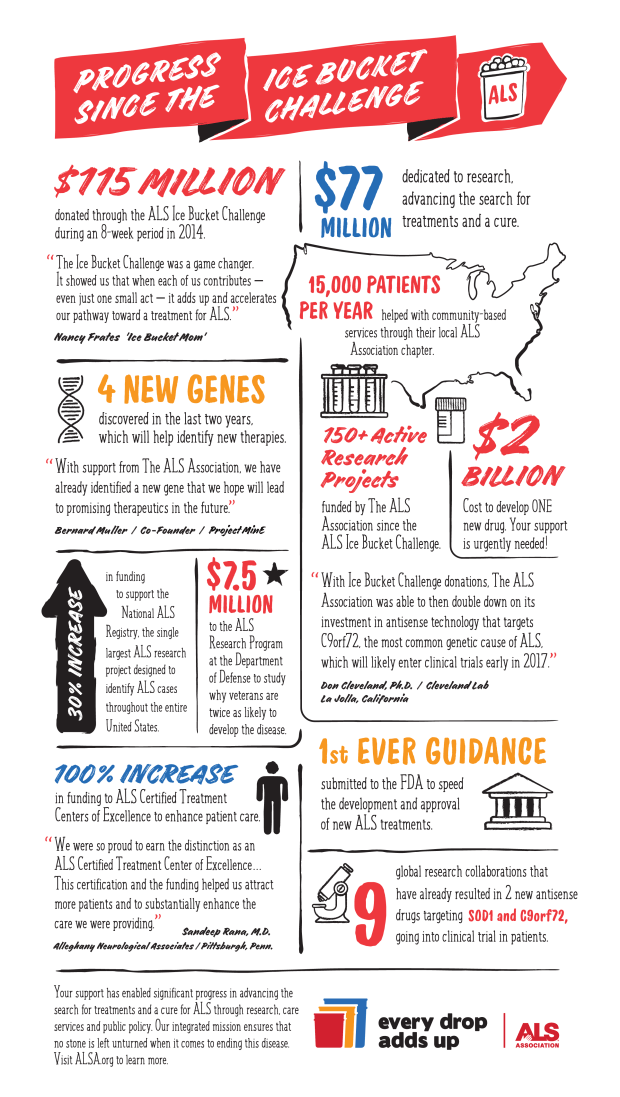
Are you wondering what the donations have accomplished so far? Check it out!

ALSProgressInfo_WhiteBoard_071416


Feeding Tube Foodie; or How I’m Being Lured to the Dark Side

The sound of the microwave whirring to life sliced through my interest in the book I was reading in the living room. I made a beeline for the kitchen where my husband Evan was clearly up to something delicious. (it was a good day for me in terms of hand strength, so I was able to steer Ruby, my beloved power wheelchair, myself) Just as I suspected, Evan was warming up some leftover pizza.

“Hey, hun. Is that your dinner?” I asked. I knew I had to play it cool to keep Evan from becoming suspicious.

“That’s the plan,” he replied, settling in at the kitchen table.

“I think I’ll just hang out here while you eat,” I said, rolling up to the table. “Hey, as long as I’m here, can I watch you eat?” I grimaced. Real smooth, Rachel.

“Um, I guess.”

“Cool, cool, cool.” Yes, keeping it casual. This time, I would control myself. I would NOT make it weird.

Evan took a bite, then another. I was riveted.

“You’re really starting at me.” He shifted in his chair.

I made a conscious effort to blink before saying, “You know, I was just wondering if you can try chewing slowly.”

With obvious discomfort, Evan complied with my request. One bite later, he stopped. “You’re leering at me. It’s freaking me out. I am going to eat in the living room.”

I huffed in frustration when he walked away. I miss food desperately, and I am always looking for ways to hold onto at least the memory of the joy of eating.

At my most recent clinic, my speech therapist put me on a pureed foods diet after she discovered that I can no longer move my tongue from side to side. Losing that motion makes me unable to sculpt my food and move it between my teeth. As a result, I have little control over where the food in my mouth goes. I am at risk of choking if I deviate from the pureed foods diet because anything I eat can slide to the back of my throat and block my airway. Even crumbs are a danger. Then there is the possibility that tiny particles of food may slip into my lungs without me even knowing it. This puts me at risk for pneumonia, which can be fatal to someone with ALS.

To protect my lungs and prevent choking, I get most of my food all of my hydration through my feeding tube (I can’t drink water because it moves so quickly that aspiration is inevitable). I eat orally at dinner, usually a pureed soup my mother-in-law Brenda made for me that morning – she concocts everything from broccoli and feta soup to savory butternut squash puree – or a fruit smoothie. I get a decent variety of flavors, but the lack of texture is starting to get to me, I fantasize about chewing on a piece of cheese or sinking my teeth into crisp slices of tomato, bell pepper, zucchini, and apple. Lately, I am nursing an obsession with all things toasted, specifically paninis. The longing keeps me up at night, and I suspect it’s chipping away at my sanity, which led to this, ahem, eccentric text exchange with a friend. Read on to witness the burgeoning madness of a Foodie on a feeding tube…

Me – I would do unspeakable things for a panini.

Melissa – Has anyone ever invented something like a chew toy for humans?

Me – Someone really should. I want to bite something and feel it crunch.

Melissa – I feel like I could put a panini in some mouth safe baggy and hold it in your mouth to feel on.

Melissa – Or I could just put a panini in your mouth and then take it back out, over and over, with purée in between so you get full.

Melissa – These might be very foolish, even offensive ideas. I just would love to please your mouth. I feel so strongly for food and I can just imagine the panini longing.

Me – no, I love it! I would drool all over a panini bag.

Me – I am desperate and the more desperate I get, the more violent I am willing to be to get what I want.

Me – I am like bargaining with some powerful dark force. ” if you let me eat a panini, I will burn down Chicago.”  **

Melissa – I can’t say I know what you’re going through, but i know it can’t be easy! When I’ve had to not eat solid food for just some period of time, i went mad.

Me – I always saw myself as a force for good, but it has taken so little to push me over the edge. Am I truly a slytherin when all my life I thought I was a hufflepuff?

Melissa – Serious hunger can push any human to the brink.

Me – Exactly. My teeth are depressed. They have lost their purpose and they are not taking it well. I think I feel at least two spite cavities forming.

Me – Can I put this conversation on my blog? I think it is a wonderful representation of my life as a feeding tube foodie

Melissa – I’d be honored.


Watch My Speech at the CDC National ALS Conference!

3

3

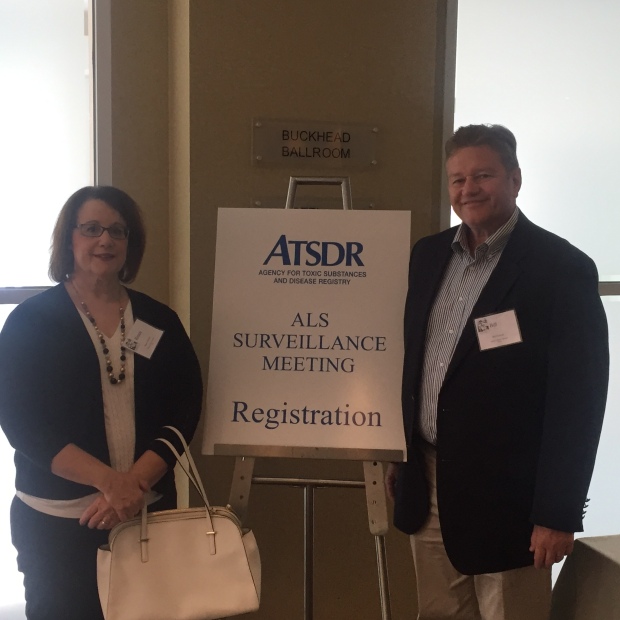
My speech at the National ALS Conference on outreach is tomorrow ( Wednesday ) at 9:30 AM EST! Due to travel complications, I am not able to attend, so my mom will be giving the speech for me! You can watch the event live at this link: http://www.alsregistrymtg.com

IMG_0492

My mom and dad register for the CDC National ALS Conference.

The Power of the Bucket List

5

The approval of Radicava, the first medicine for ALS in 22 years, had me reconsidering my post that labels my belief that I will survive this disease “wild.” Then, the vessel of  my most precious dream was wrecked on jagged rocks I never saw coming.

The federal budget for 2018 calls for the complete defunding of the National ALS Registry, and the shock of learning that my own government would so callously undercut one of the most important parts of the search for a cure left me – and I imagine many others – frightened and enraged. The budget also cut funding to Medicaid and SSDI (social security disability insurance), a fact that barely sunk in. I just didn’t know how to process the realization that the registry was in danger, and Medicaid was as well. Medicaid covers machines, medication, feeding tube supplies, caregiver fees, and so much more that we could never be able to afford on our own. On top of that, if we lost the $600 per month we receive through SSDI, how would we afford the expenses Medicaid doesn’t cover, like my daily injections of B12?

I chose to focus on saving the National ALS Registry155 a campaign I am continuing to expand. Narrowing my focus and taking action gave me a chance to salvage some of my former optimism.

Then came the second hit: a health care bill drafted in the dark that slashed Medicaid so deeply that 14 million of the most expensive beneficiaries – including the ALS community – would lose coverage and very likely their lives. My joy over Radicava seemed distant, even foolish. What good is this new treatment if we can’t afford it because our insurance has been gutted or taken away? Obstacles were coming from all sides. Rising tides of depression and fear threatened to drown me. They still do.

I had to find a path back to joy and hope in the midst of the battles I had been forced to join. Enter my inspiring friend Glynis, who made a bucket list with her husband Vince after he was diagnosed with ALS. The list helped them focus on enjoying the present, no matter how hard it got, and gave them things to look forward to. I decided to follow her example, and I came up with a list that includes both things I can accomplish despite my disease and other dreams I look forward to achieving after I am cured. Now, I have something new to think about as I try to fall asleep and worry creeps in. Have a peek at the list. What would you add to your own?

  • Give people a reason to remember my name
  • Start a new tradition
  • Go to a palm reader
  • See the Northern Lights
  • Celebrate my 50th wedding anniversary

Save Medicaid from Being Slashed!

The health care bill draft currently being reviewed by the Senate slashes Medicaid to the bone. If the bill is passed, 14 million of the most expensive beneficiaries – particularly, the elderly and disabled, including those suffering from ALS – will be kicked off Medicaid! Use the following text to write to or call your representatives and let them know that you expect them to oppose this health care bill (contact information here138). We must act quickly since senator Mitch McConnell intends to have the Senate vote by JUNE 30th!

The Honorable [NAME]
United States House of Representatives (or: United States Senate)
United States Capitol
Washington, DC

Dear Representative (or: Senator) [NAME]:

I am writing to ask for your help to ensure that people with Amyotrophic Lateral Sclerosis (ALS), also known as Lou Gehrig’s Disease have the coverage and health care they need and deserve. If passed, the Better Care Reconciliation Act will seriously impact the lives of people suffering from ALS and their families. In fact, it may even be a death sentence since many will be kicked off Medicaid.

The cost of living with ALS is staggering. Depending on the level of care a person needs, expenses can reach $250,000 per year. If patients are left with the burden of paying all the costs that Medicaid currently covers, these people will go without the feeding tube surgery and supplies that prevent them from starving to death. They will lack the medicine that relieves their tremendous pain. They will not be able to afford the caregivers who help them with toileting, medication, tube feedings, bathing, and monitoring vital machines such as ventilators. Most cruel of all, thousands will face the decision to go on a ventilator, or forgo the life-saving procedure in order to avoid bankrupting their families. In short, thousands of Americans with ALS will lose their dignity and their lives an agonizing death if they are deprived of Medicaid. (Optional: insert personal story of the impact of ALS on your life).

This is a matter of life and death, not politics. This health care bill is inhumane. I know there are a number of initiatives and programs under review. However, I think, and I hope you do as well, that Medicaid, which saves the lives of countless citizens, must be preserved and well-funded.

As a resident of (STATE), I hope that I can count on your support and look forward to watching closely as the health care bill moves through the legislative process.

(Optional) If you need more information on the impact of ALS on the people in our state, please don’t hesitate to contact the ALS Association of (STATE ORGANIZATION) at: (insert chapter website).

Sincerely,

Your Name

Help Launch Phase 2 of the “Save the National ALS Registry Campaign”!

3

WANTED! I am looking for people with experience canvassing for petition signatures. Phase 2 of my “Save the National ALS Registry Campaign” is to create and publish a guide that allows citizens to reach out to their neighbors and get signatures to send to representatives along with a letter explaining why we need them to oppose trump’s budget as long as it includes completely defunding the National ALS Registry.

Even if you don’t have experience, message me if you are willing to help do some research on how to support and mobilize advocates who are ready to pound the pavement!

Remember, this is NOT a partisan issue. You can love Trump and still advocate for the ALS community! #ALSaware #DefeatALS #NationalALSRegistry

Pacing Myself

3

I have always struggled to acknowledge and accept my limitations to the point that I often push myself far past them. From middle school through college, I participated in at least three extracurricular activities each year. OK, that’s a lie. It was more like four or five. I was in a leadership position as often as possible, too. Of course, that all came on top of a driving need to get straight A’s (and yes, I know that is a misplaced apostrophe, but I stand by it as a legitimate way to make a letter grade plural).

Latin

In high school, I was president of Latin Club. In this photo my dad and I are on a Latin Club field trip.

My first year teaching, I started the middle school book club, served on the information technology curriculum committee, proposed and planned an interdisciplinary curriculum fellowship and a fellowship to rework the English curriculum to include multicultural literature.

I love being busy, operating at full speed, running out of room in my planner, making multiple to-do lists and slashing through each item before falling into bed exhausted.

Now, though, at least half the days of the week, just functioning leaves me too tired to do anything productive. ALS puts such a strain on the body that simply existing is like running a marathon every day. Three years into this nightmare, I’m finally coming to terms with the fact that I can’t set the same amount of goals for myself as I used to. Doing that sets me up for depression, frustration, and failure. If I want to preserve my mental health and use my time well, I have to learn to prioritize and decide where to scale back. I’ve got to stop spreading myself too thin. Thus, without further ado, my freshly pruned list of goals:

1. Enact Phase 2 of my “Save the Registry” campaign (you didn’t really think I would stop at an article and blog post, did you?)

2. Fundraise for The Walk to Defeat ALS

3. Write one essay or section per week for my book on living with ALS

What I expect to sacrifice to accomplish all of this is the frequency of my blog posts and social media updates. Rather than posting every few days, I think it will only be manageable to post once every 1.5 weeks. I consider this a loss since connecting with readers is such a source of joy for me. However, I am hopeful that after I torpedo Trump’s attempt to defund the National ALS Registry and complete my fundraising efforts at the end of September, I will be able to write for my blog weekly. Getting my muscle spasms under control would also be a big help since I wouldn’t spend half the week sedated by Baclofen and Vicodin. The plan right now is to increase the amount quinine sulfate I take and undergo a test to see if installing a pump to push Baclofen directly into my spinal fluid would eliminate the spasms. The pump should increase the effectiveness of the Baclofen while diminishing the sedating side effects. I will definitely keep you posted on that.

For now, I will conclude by thanking you for your support of my writing, my health, and my dream of a world without ALS. I’ll write again soon(ish)!

“Extraordinary” Collaboration Brings Together Project MinE, Answer ALS and the New York Genome Center

3

9

Here’s something to smile about! A big thank you to #TheALSAssociation for facilitating and helping fund this collaboration and countless other invaluable partnerships. In the shadow of Trump’s attempt to defund the National ALS Registry, witnessing The ALS Association’s commitment to streamlining research efforts to push us ever closer to a cure is truly heartening!

PS I know you are wondering how The ALS Association is able to fund so much research. It is possible because of the Ice Bucket Challenge, which is coming up in August. Get ready to get wet!