My FDA Advisory Committee NurOwn Statement

Dear Drs. Califf and Marks,

I am a young woman living with ALS, and I am writing in strong support of the approval of the ALS treatment debamestrocel, which has proven to be both safe and effective in clinical trials.

ALS is a brutal enemy. This equal opportunity killer destroys the nerves that allow us to move, speak, eat, swallow, and eventually breathe. It is 100% fatal and has no cure. It can strike anyone at any time.

When I was diagnosed with ALS at age 28 in 2015, I lost everything. My body, without warning or reason, turned on me, and that meant the end of so much. My career as a 5th grade English teacher and dreams of motherhood and growing old with my husband were all swept away like sand when I believed they were stone.

Let me paint you a picture of my life with ALS. My day starts with 40 minutes of breathing treatments to prevent infection in my lungs that leave me feeling like I’m suffocating. We stop when my oxygen drops to 92.

I’m on a ventilator which is supposed to provide me with full, even breaths, but if the settings are even slightly off, it either doesn’t provide me with enough air or pushes too much too fast, forcing me to hyperventilate and pass out.

I survive on a feeding tube and haven’t enjoyed real food in 7 years. We start my “food,” a beige nutrition solution that comes in cartons, after my breathing treatment. It’s delivered to me through a pump over the course of 20 hours, often leaving me nauseous.

Because I am on a ventilator, I can’t produce sound, not even a whimper when I’m in pain. I communicate with a device called a Tobii that uses eye gaze technology. I am actually typing this letter with my eyes.

Why not write to you with my hands like a healthy person? I forgot to mention that because of ALS, I’m a quadriplegic, meaning I can only move my face. I miss being able to touch. I haven’t hugged my husband Evan in 6 years. I can’t even hold his hand. I’m totally paralyzed and totally dependent on others to meet my every need.

Imagine you can’t scratch yourself when you’re itchy, can’t adjust the thermostat or even cover yourself when you’re cold, can’t clean yourself after using the toilet. That’s my life. ALS has stripped me of my independence. I’m utterly helpless without others, and I am nothing without my machines.

The ALSFRS-R is a tool to attempt to quantify how ALS is affecting a person. A 1 score increase could be the difference between choking and eating normally or requiring a walker and walking with a minor foot drop.

The ALSFRS-R is imperfect at best. One person can have a score of 37 and be walking and breathing normally but have their hands, swallow, and voice impaired, while another person with a score of 37 could have significant shortness of breath and require a power wheelchair but have full function of their voice, swallow, and hands. It is not an accurate representation of every individual’s unique case or the changes that are occurring.

My 2015 score was 34, and my 2021 score was 1. Does a score of 1 accurately reflect me? I still communicate, live, love, smile. I have rich friendships and a healthy, passionate marriage. I’m a talented writer who raises awareness of the reality of ALS by blogging (howilivewithals.com). A score of 1 is completely unfair attempt to display ME.

Debamestrocel has achieved remarkable feats in clinical trials, including maintaining and even increasing ALSFRS-R points. Every point matters in preserving an individual’s independence and dignity. Debamestrocel also improved CSF biomarkers in ALS. No other drug has accomplished this. The benefit to those in the early phases of ALS is clear in P3 trials.

Debamestrocel is a beacon of hope to members of the ALS community, and with rapid disease progression ending in death within an average of 2 – 5 years, we don’t have the luxury of time to wait for treatments.

Give those in the early stages of ALS a chance to have more years on earth and make precious memories with their loved ones. Approve debamestrocel.

Sincerely,
Rachel Doboga

You’re Invited!

Consider this your invitation to write your own statement urging the FDA to approve NurOwn / debamestrocel! The deadline is September 20th, so get moving! The organization I AM ALS has created a wonderful guide to writing a powerful statement. Check it out! And remember, you MUST include the following:

Docket No. FDA-2023-N-2608 for Cellular, Tissue, and Gene Therapies Advisory Committee; Notice of Meeting; Establishment of a Public Docket; Request for Comments

Can AI Voice Cloning Be Used For Good?

Photo by Polina Kovaleva on Pexels.com

I’m pleased to present the link to the story for which I was recently interviewed, “Can AI Voice Cloning Be Used For Good?” by Kaleef Starks, Mark Armendariz-Gonzales, and Clera Rodrigues. The interview focused on the changes ALS has caused in my communication, as well as my experience with AI voice cloning and preservation. To read my full interview, click the book icon on the left. It’s under the heading, “Rachel’s Story.” Enjoy reading!

The 4th of July – ALS Style!

This is a photo I took on our cross-country road trip just before we crossed the Mississippi River.

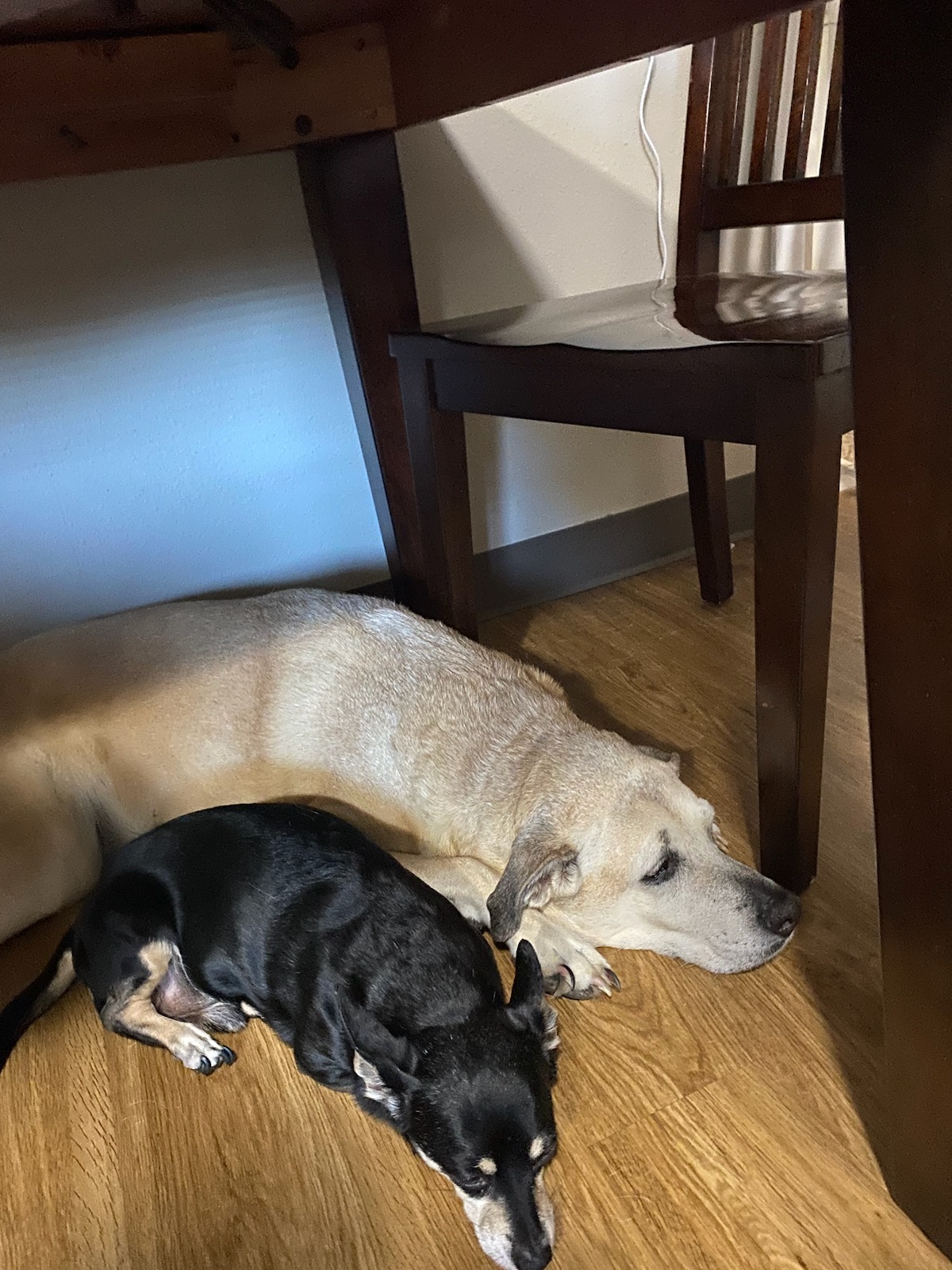
Ever since we adopted dogs, I haven’t been a fan of fireworks. They terrified Malka, our dog who passed away on September 26th, which was surprising because she was a fierce protector. She used to huddle with our other dog, a chihuahua named Pickle, to hide from the fireworks. We’re not surprised Pickle is afraid, though. As Evan says, we raised a coward. Here’s a picture Malka and Pickle huddled together. By the way, our bird Jasper is a saint during fireworks.

Pickle always got to be the small spoon.

Now that you know how our pets celebrate, it’s time to hear my idea of how to celebrate the fourth, and to me independence means a cure! Let’s start with getting me off life support – goodbye ventilator! No more food pump for my feeding tube pushing food in my stomach 24 hours a day. I want to EAT!

I will start with enchiladas from Los Gorditos in downtown Portland next to Powell’s Books. Then Thai food and falafel in the huge city block of food trucks. I will finish with Indian and Ethiopian food before heading home where Evan will make all my favorite dishes. I will end the feast with a nap with Evan.

And since I’m cured, we might as well imagine my nerves have regenerated so I can cuddle with Evan during my nap. Our last hug was 7 years ago! I want to hike and climb. We once climbed a 50 foot cliff in Great Falls, Virginia. I was strong! I want to dig for fossils and row Carlos the red canoe at sunset, splashing Evan and singing all the while. I want to drive for hours and hours on a thousand road trips. We did four major road trips, but my favorite was our cross-country trip. We went the northern route to end in San Francisco, but I want to do the southern route, too. I want to see and do everything!

Happy fourth of July!

Here’s a picture of us in Carlos the red canoe setting out for a sunset paddle on the York River in southern Virginia.

Eight Years In…

Photo by Hakan Erenler on Pexels.com

Eight years ago on June 8th, I was diagnosed with ALS. At diagnosis, I was given 2 – 5 years to live. We all are. I was just 28 years old.

After my diagnosis, I immediately said goodbye because that’s what I was told to do. I was told there is no cure for the monster that had taken over my body, my life. I posted something on Facebook to the effect of, “I’ve just been diagnosed with ALS. Thank you all for being a part of my life.” I didn’t know there were other options, that even without a cure I could fight.

My fantastic ALS clinic connected me with the local chapter of the ALS Association and suddenly I had a power wheelchair, a Tobii eye gaze computer, and a cough assist machine, and I was trained to use it all. I had many long conversations with my neurologist, pulmonologist, social workers, husband, and family, and decided to go on a ventilator when the time came. I’m now a bedbound quadriplegic on life support and survive on a feeding tube. I’m very lucky because I live at home despite my high needs. My husband Evan works tirelessly, seeing to my every need. He is the reason I fight. I would do anything to stay by his side.

When I was diagnosed, we were about to start a family. I can’t have kids so we were researching adoption agencies. We decided to adopt siblings because they are hard to place. I even made a Pinterest board with resources for adoption and raising creative, resilient, grateful, vegetarian children. I also had a list of 27 parenting books we were planning to read together. We were going to be READY, but you know what they say about the best laid plans…

Eight years in, I’m starting to forget what it was like to speak and move. I guess it’s for the best since I will never talk or walk again. I remember certain things, though, like playing Who’s the Judge with my family at the kitchen table after dinner. We would sit in a circle and when it was your turn, you said a silly phrase in an even sillier accent. Everyone else had their eyes closed and would try to guess who the speaker was. Looking back, it was a ridiculous game. It was only my parents, sister, and me so it was easy to tell who had spoken by location alone. Plus, we always took turns in the same order. We all had fun, though.

I remember the first time I spoke Russian in Russia and someone understood me. It was like the best magic trick ever. My first words were to the taxi driver bringing me from the airport to my new home for the summer.

“I’m afraid,” I told him.

“Why?” he asked.

I explained I was worried the door to the apartment wouldn’t open. He promised to stay until I got inside. The magic trick worked.

I remember dancing with Evan with my Walker between us in the living room, his strong hands firm on my hips keeping me safe as we swayed softly, softly to Frank Sinatra. No more swing dancing for us. In our first Ice Bucket Challenge, Evan said, “I’m doing this so I can dance with my wife again!”

I remember dancing with dad on his feet in a living room across the country 30 years ago, usually to something loud like Eric Clapton. “Layla” was my favorite because every time it came to the part where Eric Clapton sings, “You got me on my knees Layla!” dad would set me down and fall on his knees in front of me.

These losses don’t hurt anymore unless I focus on precise moments I’m able to fish out of the murky depths of my memory. I have learned better than to do that. They only ache now.

I miss my old self, the creative, playful teacher, the fossil hunter, the singer, the traveler. I’m reminded of the lyrics to “Summertime Sadness” by Lana del Rey: “Think I’ll miss you forever like the stars miss the sun in the morning sky… Even if you’re gone I’m gonna drive!”

I Am Not OK

4

3

2

As I write this, I am sitting in bed, watching a funny show while checking my email, text messages, and Facebook notifications. It is the middle of the night, a time of terror for me, so I need the safety of the blue electronic light of my devices. I bask in the glow, then I drown my thoughts in sitcom banter and a whirlwind of multitasking.

Burying my dark thoughts is a high stakes game; if I don’t use the right maneuvers, the shadows win. No matter how scared I am now, it is nothing compared to how I will feel if the memories creep in. The memories open the floodgates of flashbacks, which will sweep me far away and back in time to that room where I was raped and nearly murdered.

I escaped with my life, but certain parts of me died there, namely the part that believed no one would ever hurt me. Well, actually I had never really considered that I could be a story on the news as easily as any other human. I held myself apart in the way we all must to some degree if we want to function in the world. Dwelling on our abject vulnerability would reduce us to terrified shells of ourselves.

Like me.

I can’t close my eyes in the dark. I can no longer write, I can’t focus on reading. All I can do is mindlessly watch TV.  I am afraid to sleep because I want to remain vigilant, and I know nightmares are waiting for me. I am resuming therapy, but I am desperate for a quick fix. I know that no miracle pill exists to give me relief, but I have been living with PTSD for eleven years, never knowing when it will become active and derail my life. I’m exhausted.

Evan says to go easy on myself. Getting frustrated with myself does great harm and zero good. I can’t berate myself into ending the episode. I guess it’s time to learn to show myself the compassion I apparently think everyone but me deserves. After all, if I am not on my own team when I’m at my weakest, how will I fight my way through this? I know that logically. Now I have to figure out how to live that truth.

Wish me luck. I need it.


Unabridged: “Is Your Doctor Hurting Your Mental Health? Why You Need an Emotionally Intelligent Doctor and How to Find One”

3

3

2

If you are anything like me, you do a little research before choosing a doctor. Patients can easily learn about the traditional aspects of their doctor’s qualifications, such as the college they attended, years practicing, and awards earned, with a simple Internet search. However, it’s quite a bit harder to get a feel for a doctor’s emotional intelligence. Emotional intelligence is the ability to think and gather information about emotions, and then to use that information to achieve goals. Goals may include managing one’s own or others’ emotions, like staying calm, cheering someone up, or deciding how to share important news.

Whether or not your doctor practices emotional intelligence will make an enormous impact on the quality of your care and mental health. At best, a doctor lacking emotional intelligence can make you feel unheard, unimportant, or confused. At worst, you may end up feeling completely devalued or even traumatized.

Let’s travel back in time one week. Zoom in on me lying on the table in the OR. Right away, things started going wrong. I stayed on the table for a half hour while nurses darted around me like frightened birds, trying to find out where the surgeon was through every phone and pager in the room. One nurse even ran out into the hall to ask random people the question on everyone’s lips: “Where is Jeff?” I knew the instant he finally arrived because he owned that room. Even though my face was covered, I could feel him walk towards me, the nurses falling silent as he passed. He never paused his diatribe about paperwork and how he refuses to do another page today. He didn’t even stop when he put his hands on me. I remember thinking, he should see my face, speak my name, explain the procedure to me, anything to indicate that he knew he was touching a sentient, feeling being. That’s what an emotionally intelligent doctor would do. When he touched me, I felt like a piece of meat.

Next, the team couldn’t sedate me because of my low blood pressure. I was paralyzed when I heard this. That’s right, heard as in, overheard. No one said, “Your blood pressure is pretty low. Has this ever happened before?” No one said, “If we do this procedure right now, you won’t be able to have a sedative. How do you feel about proceeding?” Taking care of a patient means approaching him or her with empathy. A cornerstone of emotional intelligence, empathy consists of admitting ignorance about a person’s inner life and taking steps to remedy that ignorance by asking questions and imagining a different perspective. However, Dr. Jeff was too busy ranting about his least favorite nurses and why they should get fired to address me, much less ask for my opinion.

The team gave me Lidocaine, which didn’t cut it – pun intended. Apparently, Dr. Jeff remembered he was operating on a person because he finally spoke to me: “You are going to feel just a little pressure here.” I braced myself. Then, a fire alarm went off in my brain, screeching, “Sharp! Sharp! Sharp!” as red strobe lights blinded me. I cried out when I felt the blade going in and out of my skin.

“You are going to feel pressure, there’s nothing wrong with that,” Dr. Jeff patronized. Did he forget I was not sedated?

The next thing I heard was, “Wow, she is bleeding all over the place.” This is not what you want to hear immediately after someone slices your jugular. It seems that one of my medications contains an anticoagulant. At that point, an emotionally intelligent doctor would have addressed me to manage my emotional experience of the surgery and reassure me. You probably know Dr. Jeff well enough by now to realize that this didn’t happen. In fact, after he closed the artery, he joked, “Now don’t go repeating anything you heard in here.” Naturally, I interpreted this comment to mean, “Hey, Right Shoulder and Side Neck, thanks for being such a good sport. Feel free to publish this experience as a non-example in your article on emotional intelligence in ALS News Today.” So here we are.

Apparently, a lot went right with the surgery. The results were exactly as hoped for. Still, imagine my surprise when I returned to my room to find my mother and husband smiling. They squeezed my hand, kissed my forehead, and told me how brave I was. “The surgeon stopped by and said that the procedure was a success!” my mom said.

It was then that I started to cry. The experience of being helpless to pain and violence dragged me back eleven years to the night I was nearly murdered. My PTSD symptoms flared to life; anxiety and depression crept in, first through nightmares, then into my waking life. I kept thinking about how different my mental state would be if Jeff had just spoken to me. I remembered how my would-be killer barely spoke to me, either. Why would he? I was meat to him, too.

How does the term “medical success” not take patient experience into account? Answer: when the success is being described by a doctor who shows zero emotional intelligence. No one deserves this treatment, especially not those made vulnerable by disease. Emotional intelligence in doctors is an absolute must, just as vital as the medical degree that allows them the privilege of being in the room with you.

Lucky for me, the doctor I see most frequently, a neurologist named Dr. Goslin, is an expert at practicing emotional intelligence. From the moment I stepped into her office, I felt like I was the most important person in the world to her. She wanted to know all about me, way beyond my ALS story. In fact, she knows as much about me as some of my friends do. The day I met her, all she wanted to do was listen. Then, she asked me about my emotional state and medical goals. I told her I felt positive, ready to fight, and I wanted to survive this terminal, currently uncured disease.

Her response? “I think that’s a great goal, and with the way research is going we definitely have reason to hope.” I knew what I had said would be laughable to many people, but she managed to respect my feelings without making me promises she couldn’t deliver. That conversation set the tone for every future interaction we had. We follow a treatment plan that focuses on the goal of survival by staying ahead of the disease and minimizing its strain on my body while I wait for the cure. Dr. Goslin used emotional intelligence to learn about me and achieve her goal of designing a treatment plan for me, not just my disease. Now every time I see her, I feel empowered. She is an important part of keeping my mind healthy.

When I decided to write about how the emotional intelligence of doctors can affect a patient’s mental health, I asked Dr. Goslin if I could interview her. She agreed with enthusiasm.

At the beginning of the interview, she said, “I think that emotional intelligence as you have defined it is one of the most important aspects of being a good clinician. Acknowledgement of the importance of emotions is part of treating the whole person and not just the disease. [However], my medical training did not address this aspect of care at all.  There wasn’t any acknowledgement of the importance of emotions (of the patient or of the self) in caring for patients.”

Well, that explains Dr. Jeff, but what about Dr. Goslin? Where did she learn about emotional intelligence and how to practice it?

“I have attended various educational meetings regarding awareness of this topic, particularly based on mindfulness, meditation, and being in the moment. It is definitely something that I cultivate,” Dr. Goslin said.

She went on to explain, “A lot of emotional intelligence comes from experience and a willingness to be open to emotions, both mine and others. When emotions arise that would typically be unpleasant or uncomfortable I tend to allow them to flow over me, and I sit with them, without actually judging them as negative. I then use awareness of the emotions to help determine what the patient finds most important to have addressed and how best to do this.”

Being a doctor who practices emotional intelligence sounds difficult, even draining, but Dr. Goslin can’t imagine treating her patients without interacting with their emotions. “I believe that patients’ emotional response to disease and to their care factors heavily into how effectively they can be treated. Fear and anger are two common emotions that occur in the setting of illness and that can impede medical treatment. Often when a doctor can recognize and address these emotions, road blocks to treatment can be removed.”

“How does practicing emotional intelligence affect you on a personal level? Is it challenging?” I asked.

“I think that emotional intelligence sometimes allows me to have a closer relationship with patients, which can make my sorrow for the patients more extreme. It is also important but sometimes difficult to recognize my own emotions and not let them interfere with patient care. For example, before going into a room to give a patient a diagnosis of ALS, I might be feeling fear and anxiety about how the patient will accept the diagnosis and how well I will be able to respond to the intensity of emotions that are likely. I have to control these emotions so that the patient can be the appropriate center of focus.”

When I asked her what emotional intelligence brings to the table when dealing with a terminal disease like ALS, she answered with the optimism that is perhaps her defining characteristic: “While ALS is terminal, it is not without treatment and hope. I think that use of emotional intelligence results in a closer patient doctor relationship and builds a level of trust and openness. I hope that the positive emotions that I bring to treating diseases (even terminal ones), increases the likelihood that patients will also have positive emotions.”

So, how can you find the emotionally intelligent doctor you need and deserve to keep your mind mighty? Dr. Goslin, of course, has the answer. “In some ways, I think the web based assessments of doctors can reflect their emotional intelligence because I believe that patients have greater satisfaction when treated by a doctor with emotional intelligence. Of course these assessments can be also be done by patients who are unhappy with a doctor for  unrelated reasons, like the doctor wouldn’t prescribe narcotics.”

Keeping that caveat in mind, I recommend using the following free sites for finding reviews: healthgrades, RateMDs, Yelp, and Zocdoc. Once you have a list of a few you like, you can call each doctor’s office or sometimes even email the doctor directly to ask if he or she follows what I call “The Goslin Equation:” mindfulness + meditation.

Need help planning what to say during your phone call or in your email? Check out this script:

“I am interested in working with a doctor who practices emotional intelligence. How is emotional intelligence part of the way you treat patients? Can you tell me if you have had any mindfulness or meditation training?”

Now go get the fantastic care you deserve!

Abridged version originally published by ALS News Today on October 2, 2017


Dr. Jeff, the Jugular, and Me

To be read with “Is Your Doctor Hurting Your Mental Health? Why You Need an Emotionally Intelligent Doctor,” originally published by ALS News Today, October 2, 2017

Whether or not your doctor practices emotional intelligence will make an enormous impact on the quality of your care and mental health. At best, a doctor lacking emotional intelligence can make you feel unheard, unimportant, or confused. At worst, you may end up feeling completely devalued or even traumatized.

Let’s travel back in time one week. Zoom in on me lying on the table in the OR. Right away, things started going wrong. I stayed on the table for a half hour while nurses darted around me like frightened birds, trying to find out where the surgeon was through every phone and pager in the room. One nurse even ran out into the hall to ask random people the question on everyone’s lips: “Where is Jeff?” I knew the instant he finally arrived because he owned that room. Even though my face was covered, I could feel him walk towards me, the nurses falling silent as he passed. He never paused his diatribe about paperwork and how he refuses to do another page today. He didn’t even stop when he put his hands on me. I remember thinking, he should see my face, speak my name, explain the procedure to me, anything to indicate that he knew he was touching a sentient being. That’s what an emotionally intelligent doctor would do. When he touched me, I felt like a piece of meat.

Next, the team couldn’t sedate me because of my low blood pressure. I was paralyzed when I heard this. That’s right, heard as in, overheard. No one said, “Your blood pressure is pretty low. Has this ever happened before?” No one said, “If we do this procedure right now, you won’t be able to have a sedative. How do you feel about proceeding?”

Taking care of a patient means approaching him or her with empathy. A cornerstone of emotional intelligence, empathy consists of admitting ignorance about a person’s inner life and taking steps to remedy that ignorance by asking questions and imagining a different perspective. However, Dr. Jeff was too busy ranting about his least favorite nurses and why they should get fired to address me, much less ask for my opinion.

The team gave me Lidocaine, which didn’t cut it – pun intended. Apparently, Dr. Jeff remembered he was operating on a person because he finally spoke to me: “You are going to feel just a little pressure here.” I braced myself. Then, a fire alarm went off in my brain, screeching, “Sharp! Sharp! Sharp!” as red strobe lights blinded me. I cried out when I felt the blade going in and out of my skin.

“You are going to feel pressure, there’s nothing wrong with that,” Dr. Jeff patronized. Did he forget I was not sedated?

The next thing I heard was, “Wow, she is bleeding all over the place.” This is not what you want to hear immediately after someone slices your jugular. It seems that one of my medications contains an anticoagulant. At that point, an emotionally intelligent doctor would have addressed me to manage my emotional experience of the surgery and reassure me. You probably know Dr. Jeff well enough by now to realize that this didn’t happen. In fact, after he closed the artery, he joked, “Now don’t go repeating anything you heard in here.” Naturally, I interpreted this comment to mean, “Hey, Right Shoulder and Side Neck, thanks for being such a good sport. Feel free to publish this experience as a non-example in your article on emotional intelligence in ALS News Today.” So here we are.

Apparently, a lot went right with the surgery. The results were exactly as hoped for. Still, imagine my surprise when I returned to my room to find my mother and husband smiling. They squeezed my hand, kissed my forehead, and told me how brave I was. “The surgeon stopped by and said that the procedure was a success!” my mom said.

It was then that I started to cry. The experience of being helpless to pain and violence dragged me back eleven years to the night I was nearly murdered. My PTSD symptoms flared to life; anxiety and depression crept in, first through nightmares, then into my waking life. I kept thinking about how different my mental state would be if Jeff had just spoken to me. I remembered how my would-be killer barely spoke to me, either. Why would he? I was meat to him, too.

How does the term “medical success” not take patient experience into account? Answer: when the success is being described by a doctor who shows zero emotional intelligence. No one deserves this treatment, especially not those made vulnerable by disease.

A Dream

If my dream of collecting and expanding my best essays and turning them into a book ever becomes a reality, there are a few new topics I am dying to write about that are just too involved for my blog. I would devote a whole chapter to the ways ALS has changed my understanding of gender, and then another chapter on how the changes ALS has wrought upon my body fit into my lifelong, desperate quest for beauty.

Oceans Between Me and You

Lately, I feel like the little girl in this music video – that I have to put on a cape and mask just to face the world and my increasingly isolated place within it. Of course, that’s not a healthy or sustainable way to live, but I try all the same. Perhaps I try because I prefer the dull ache of wearing my cloak to the sting of vulnerability that comes with allowing the whole world to see my wounds. I doubt that I am alone in this, so maybe simply sharing the feeling will be helpful even if I can’t expose the words written on my back  for fear that they are true.

Sleepwalking

Tonight, after reading and listening to a podcast for a few hours, I felt stir-crazy from sitting for so long. I needed to get up. Specifically, I felt like trying out the Movements I saw on the Netflix series “The OA”. I was just about to do that when I remembered I could not get up.

This is not the first time I have forgotten my limits. Sometimes when I wake up, I plan on walking to the closet to pick out my clothing. It takes a few seconds of trying to swing my legs the edge of the hospital bed (how I miss the ankle-aching cold of morning floorboards beneath my bare feet!) to remember I can’t walk that far.

Perhaps I forget because I can walk in my dreams. Every time. However, even in my dreams, I am aware that walking is unusual for me. Usually, I dream that I am walking and then suddenly remember that, like Cinderella and her pumpkin and rag dress, my legs will return to being essentially useless by midnight. Sometimes, I even feel them weaken and my knees buckle. Even in my dreams, I cannot escape my disease.

Shrugging off the crushing weight of realizing my disability anew, I force myself to forget that I am stuck sitting and will continue sitting for the rest of my life, or until a cure is found. I look at Evan and my pets and try to let the feeling of being loved overwhelm the feeling of being trapped.